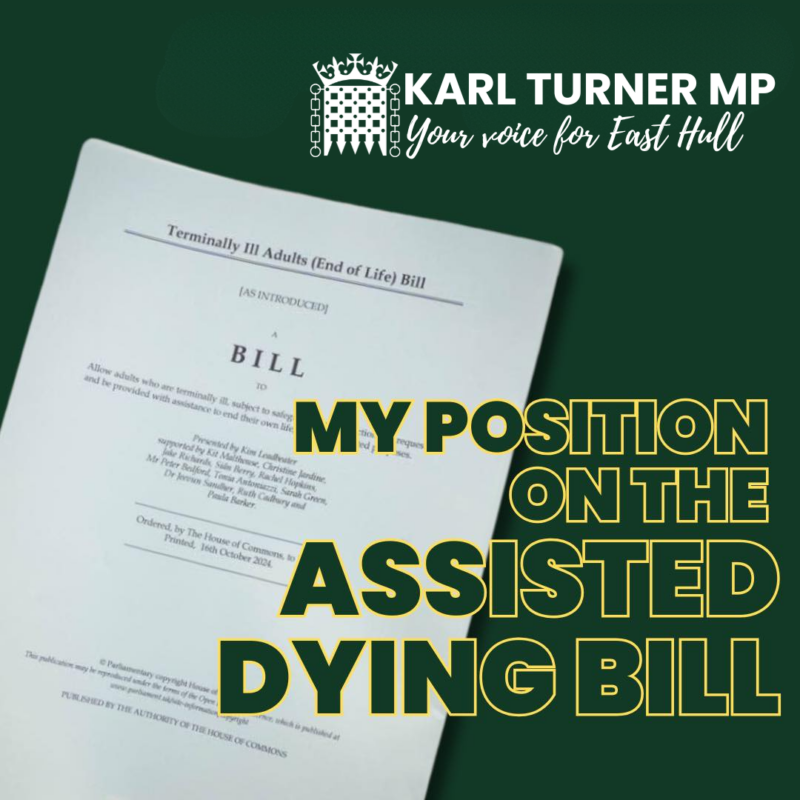
Karl Turner MP Statement on The Terminally Ill Adults (End of Life) Bill Third Reading
As the Assisted Dying Bill approaches its third reading, for me, the basis for my decision has moved from one of principle to one of pragmatism.
When the Assisted Dying Bill was last debated in the House of Commons in 2015, I supported fairly enthusiastically. Similarly, my decision to vote in favour of Kim Leadbeater MP’s Bill on 29 November last year was based on a belief in respecting individual autonomy, provided that strong protections are in place for vulnerable people. Despite providing my support at the second reading, I have since decided to withdraw my support.
I have decided that I can no longer support the current form of the Bill although I remain committed to the principle that individuals facing terminal illness deserve autonomy in how they approach the end of their lives. Nevertheless, I now have serious reservations about the safeguards proposed in this version of the proposed legislation.
The original proposal included a requirement for a High Court Judge to approve the decision once two doctors have confirmed eligibility. This is not particularly uncommon. High Court Judges are sometimes tasked with the terribly difficult decisions such as ending life support for patients once medical professions have concluded that there is little hope of recovery.
As a lawyer, I viewed this judicial oversight as an essential safeguard so I am particularly concerned by the proposed replacement with Assisted Dying Review Panels, as outlined in clauses 4 and 14 to 16 of the bill. I do not believe the bill now provides the same level of protection.
Judges are not shackled by their own religious belief or political prejudices. They come to their judgement after carefully considering the evidence and do so completely objectively, independent of any pressure and with absolute impartiality. I fear that coercion is one of the biggest risks associated with this bill; and it is something that I am concerned that would not be addressed correctly if this bill is allowed to remain in its current form. If any subsequent inquest found someone’s death was in part related to coercion that was not picked up to weakened safeguards, it would be a blight on all of our consciences.
As Gordon Brown, the former Prime Minister, identified in The Guardian this week, the issue of palliative care is not raised in the bill. If the Government invested heavily in palliative care alongside this bill, then a legitimate choice would be on the table for people suffering from terminal illnesses; however, give the state of palliative care, it is not a real choice.
At present, only about 60% of hospitals provide 7 day a week palliative care; and only 1/3rd of the funding in hospices is from the state. Clearly, then, the state is not providing sufficient enough investment in palliative care to ensure that those people who would prefer assisted living to assisted dying are provided with the choice they deserve.
It is for these reasons that I am now unable to support the bill at its third reading and will walk away with a clear conscience knowing that I gave this proposed legislation the very careful scrutiny.